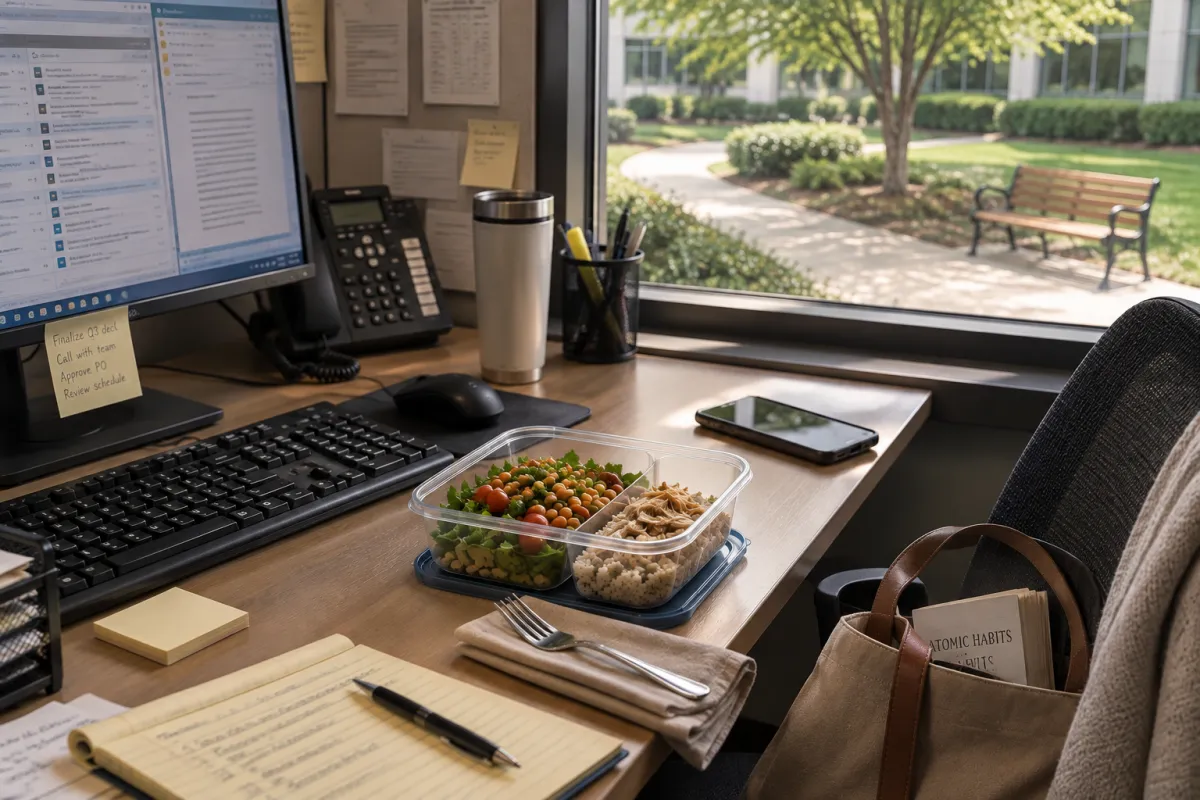
Working Through Lunch: When Your Lunch Break Stops Being Yours
THE PATTERN LIBRARY™
PN-018
The Lunch Break
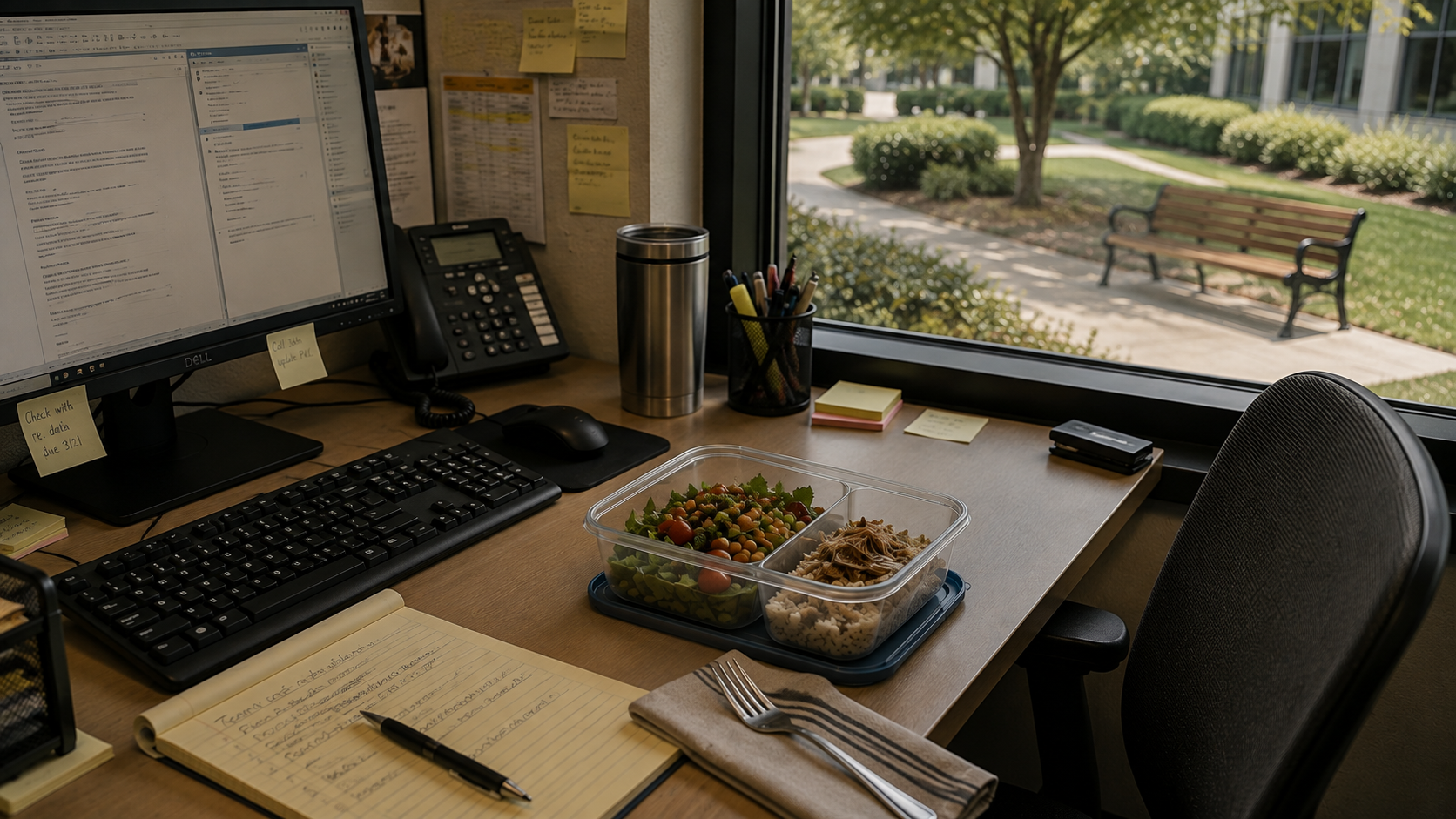
There is a version of the lunch break that seems almost embarrassingly modest when you think about it.
Not an hour at a restaurant or some elaborate escape from the middle of the day. Just enough time to step away from whatever has occupied the morning and allow yourself to be somewhere else for a little while.
Maybe you bring a book and imagine reading a few pages while you eat. Maybe there is a walking path near the office you've passed a hundred times and thought you might finally use. Maybe you simply picture yourself sitting somewhere away from your desk, eating lunch without simultaneously answering a question, returning a call, or trying to finish something before the afternoon begins.
Twenty minutes, perhaps.
Nothing extravagant.
And most mornings, it still seems possible.
The lunch is waiting in the refrigerator. The book is tucked into your bag. The walking shoes might even be in the car.
Then noon arrives.
There hasn't necessarily been a crisis. No one has announced that lunch is canceled. There may not even be anything particularly urgent demanding your attention.
There is simply an email you could answer before you leave. A report that would feel good to finish. A phone call that should only take a few minutes.
You tell yourself you'll take the break as soon as you're done.
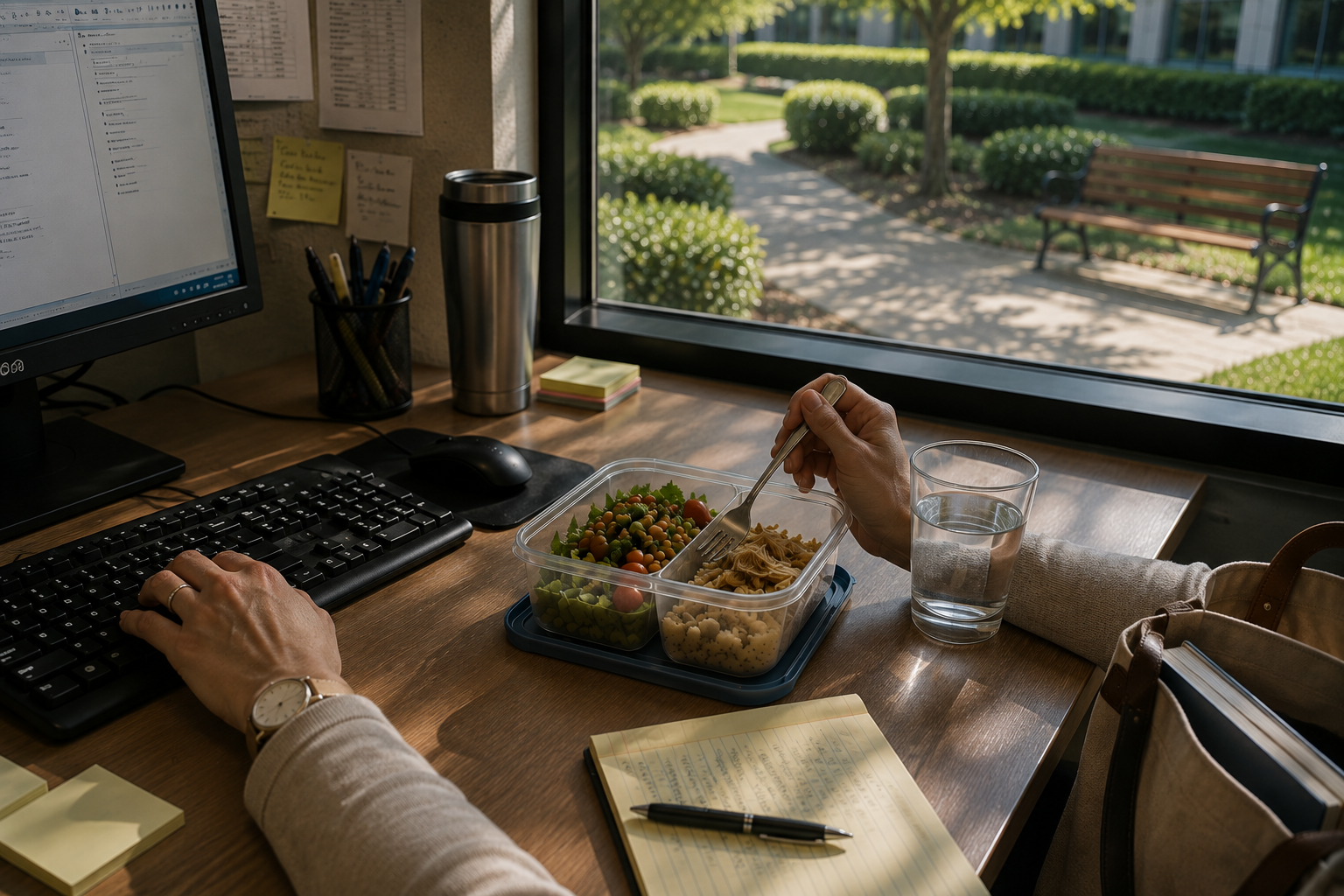
So you open your lunch while you're waiting for someone to answer the phone. You take a few bites while reading the email that came in during the call. You answer that email because you're already sitting there.
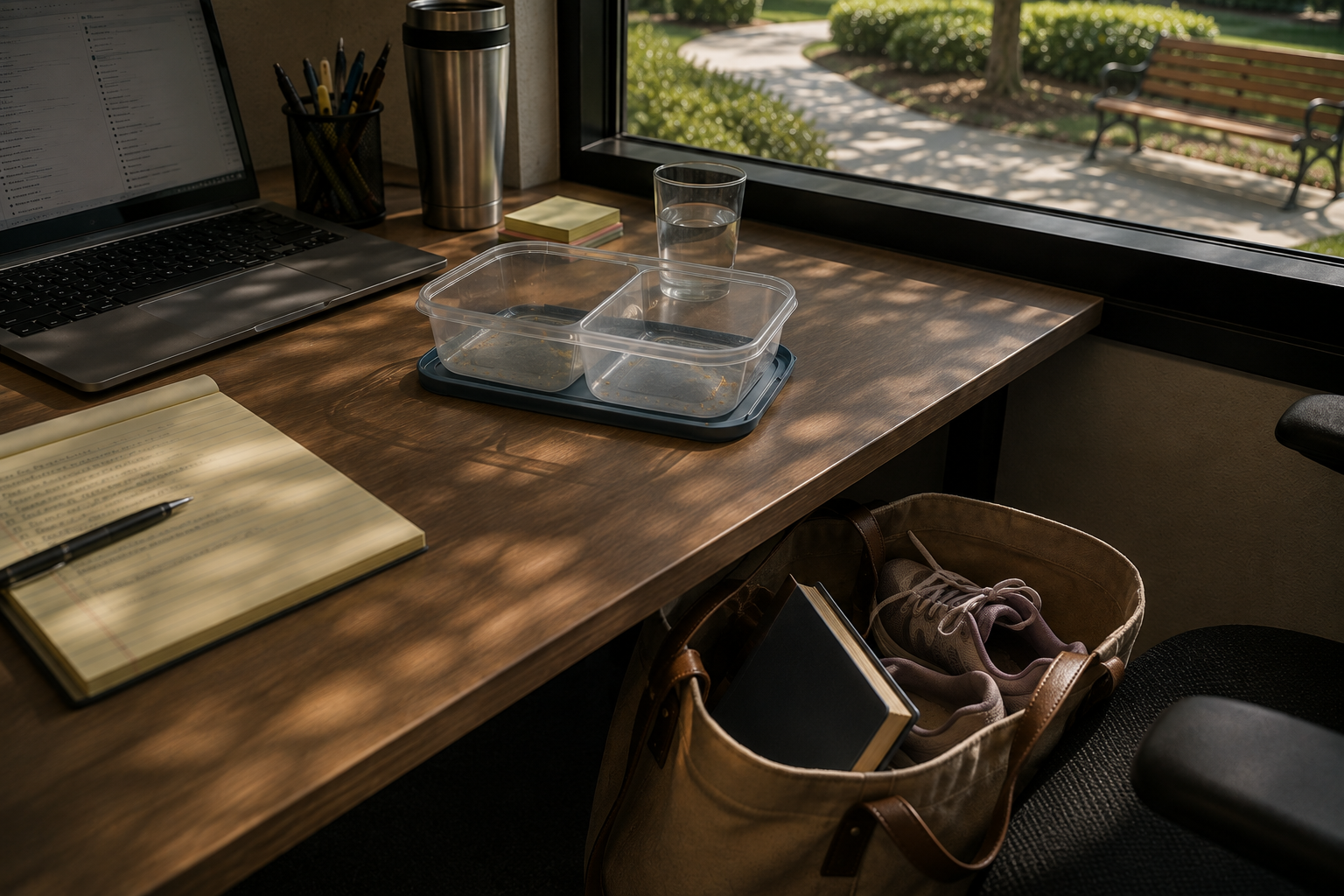
And sometime later, you look down and realize the container is empty.
Lunch happened.
The break didn't.
That distinction is easy to miss because, from the outside, nothing appears to have been sacrificed. You ate. You finished the report. You answered the email. Maybe you even got a little ahead before the afternoon began.
It can feel strangely satisfying. Efficient. Responsible. Like evidence that you used the time well.
Which may be exactly why the exchange is so difficult to notice.
Because unlike the Saturday morning that disappeared beneath errands and favors, no one necessarily asked you for this time.
No one interrupted the walk or told you not to read the book. No one said you couldn't leave your desk.
The twenty minutes were there.
And somehow, without ever consciously deciding that something else deserved them more than you did, you gave them back.
The Permission
At some point, leaving your desk for lunch begins to feel different than staying.
Staying requires almost no explanation. You can eat while you work, answer one more email, finish one more task, or remain available in case someone needs you, and the decision blends so naturally into the workday that it barely registers as a decision at all.
Leaving is different.
Leaving requires you to stop while something remains unfinished. To close the laptop when there is still an email you could answer. To walk away from a task that could be completed now instead of twenty minutes from now.
None of those things should feel particularly significant. And yet, somewhere along the way, taking the break can begin to feel like the choice that requires justification.
You look at the clock and calculate whether you really have time. You glance at the inbox before deciding whether to go. You think about what still needs to be finished that afternoon and tell yourself you'll leave tomorrow, when the morning isn't quite so busy.
Or after this project is finished.
Or when you're caught up.
There is something almost peculiar about the phrase caught up when you think about it, as though there might eventually be a moment when every email has been answered, every task completed, every request handled, and nothing new is waiting to take its place.
Only then, apparently, would twenty quiet minutes feel completely justified.
Of course, that moment rarely comes.
Work has a remarkable ability to expand into whatever time remains available to it. And when there is always something else that could be done, the things that produce visible evidence can begin to feel more legitimate than the things that don't.
The email gets answered.
The report gets finished.
The phone call gets returned.
When those twenty minutes are over, you can point to something that wasn't finished before.
The walk leaves no such evidence.
Neither does sitting quietly while you eat lunch. There is no completed task to show for looking out a window for twenty minutes. No one sends an email thanking you for reading a chapter of your book. Nothing gets crossed off a list because you stepped outside and noticed that the weather had changed.
Perhaps that is why productivity makes such an easy substitute for the pause.
It gives the time something visible to account for.
And for someone who has spent years measuring a good day, at least in part, by what was accomplished, time without an obvious purpose can begin to feel strangely difficult to claim.
Not because you don't want the pause.
Because you've become accustomed to proving that your time was well spent.
Perhaps this is why the pattern can remain invisible for so long.
We tend to notice the things we're prevented from doing. The meeting scheduled through lunch. The urgent phone call. The deadline that genuinely cannot wait. Those moments give us something to point to and say, That's why I didn't take the break.
But what do we point to on the days when nothing actually prevented it?
Those days leave much quieter evidence.
The email you chose to answer. The task you decided to finish. The lunch container beside the keyboard. The empty path outside the window.
None of them looks particularly important.
Together, however, they begin to suggest something worth examining.
The question may no longer be whether you can take the break.
Technically, you can.
The question is whether you can take it without feeling that you should be doing something else.
And those are not the same thing.
Perhaps the pause began to disappear long before anyone asked you to give it up.
Perhaps it began disappearing when using the time for something productive stopped feeling like a choice at all.
The Evidence
The evidence of this pattern is rarely found in a single lunch.
One afternoon at your desk means almost nothing. Neither does the week when everything really was unusually busy, or the month when a project required more of you than usual.
Life has seasons.
Sometimes the pause genuinely has to wait.
But patterns reveal themselves differently.
They appear when the unusual becomes ordinary.
When you realize you cannot remember the last time you actually left for lunch.
When the book that once traveled back and forth in your bag has quietly migrated back to the nightstand because you stopped opening it.
When the walking shoes disappear from the car.
When someone asks if you'd like to go somewhere for lunch and your first thought isn't whether you'd enjoy it, but whether you can justify being away that long.
The evidence isn't simply that you stopped taking a break.
It's that somewhere along the way, you stopped expecting one.
That is a much quieter change.
And perhaps a more consequential one.
Because there was probably a time when noon still presented a choice.
You might take the walk or you might not. You might read a few pages or decide to finish the report instead. You might sit outside one day and stay at your desk the next.
The possibilities were still there, even when you didn't choose them.
But after enough afternoons spent exactly the same way, something begins to change.
You don't consider the walk and reject it.
You don't imagine sitting outside and decide against it.
You don't look at the book in your bag and consciously choose the inbox instead.
Eventually, the book stays home.
The shoes aren't in the car.
The bench outside the window is still there, but it has become part of the scenery rather than somewhere you might actually sit.
There is no longer much of a negotiation because there is nothing left to negotiate.
This is simply what lunch looks like now.
There is something unsettling about realizing how easily expectation can disguise itself as reality.
"I don't have time to take lunch."
Maybe that's true.
But perhaps the more interesting question is how often we still check.
Not by looking at the clock or studying the calendar, but by noticing whether another possibility ever entered the conversation.
Do we actually know there isn't time?
Or have we repeated the same exchange often enough that we've stopped looking for the possibility?
Because a pattern doesn't need to remove an option completely in order to influence us.
It only needs to make one option feel more natural than another.
Working through lunch feels normal.
Walking outside begins to feel optional.
Answering the email makes sense.
Reading the book can wait.
And slowly, without any single decision important enough to remember, the hierarchy establishes itself.
The things that need something from you remain.
The things you wanted for yourself become increasingly negotiable.
Until eventually, even the wanting begins to quiet.
That may be the evidence worth paying attention to.
Not the lunch you ate beside the keyboard.
Not even the break you didn't take.
But the distance between what you once imagined you might do with that small piece of your day...
and what you eventually stopped expecting from it altogether.
Because once you stop expecting the pause, no one has to take it from you.
You have already learned to live without it.
The Pattern
Perhaps that's why the lunch break matters more than its twenty minutes would suggest.
Not because taking a proper lunch is the secret to a better life, or because every afternoon should contain a walk, a book, and an empty bench beneath a tree.
The lunch break matters because it gave us something small enough to observe.
We could watch the exchange happen.
At first, there was a pause and a choice about what to do with it. Sometimes work won. Sometimes something else might have.
Then one choice became more familiar than the other.
Eventually, the choice itself became difficult to see.
And once you recognize that progression in something as ordinary as lunch, it becomes difficult not to wonder where else it may have happened.
Perhaps there was once an evening when you imagined doing something after dinner simply because you wanted to, before the evening became the place where everything unfinished from the day gets deposited.
Perhaps there was a Saturday you expected to protect before errands, obligations, and small reasonable requests became what Saturdays were for.
Maybe there is a trip you've talked about taking for so long that you've stopped researching it.
A class you once thought you'd sign up for.
A project you meant to begin.
A place you wanted to see.
Something you wanted to change.
Something you wanted to become.
None of those things necessarily disappeared because someone told you that you couldn't have them.
That would be easier to recognize.
Sometimes there was simply something more immediate to do first.
Something practical.
Something responsible.
Something useful.
And when that happens often enough, the things we intend for ourselves can begin moving farther away without ever being formally abandoned.
We still want them.
We still mean to get to them.
We may even continue telling ourselves that we will.
Just not today.
Not this week.
Not while things are so busy.
Not until this project is finished, the kids need less, work settles down, the money is better, the timing makes more sense, or life finally creates the opening we've been waiting for.
And perhaps that's why the evidence sitting beside the keyboard is worth examining.
Because the lunch break didn't disappear in one dramatic decision.
It became negotiable.
Then familiar.
Then expected.
Until eventually there was nothing unusual about giving it away.
Perhaps some of the larger things we've postponed have followed a similar path.
Not because they weren't important.
Not because we consciously decided against them.
But because we became very good at choosing everything that came before them.
And if that possibility feels uncomfortable, perhaps it should.
Because there is a difference between deciding that something no longer belongs in your life...
and slowly becoming accustomed to living without it.
The lunch break is only twenty minutes.
But perhaps twenty minutes was never what we were examining.
Perhaps we were examining what happens when something that belongs to you becomes negotiable often enough that, eventually, you stop expecting it at all.
The Question That Remains
Perhaps the question isn't whether you take your lunch break tomorrow.
You may.
You may not.
Either choice could be entirely reasonable.
The more interesting question appeared somewhere between the book that stopped traveling with you, the walk you stopped considering, and the twenty minutes you gradually stopped expecting.
Because once something has become ordinary, it can be difficult to remember that it was ever a choice.
And if that can happen to twenty minutes in the middle of an ordinary day, perhaps the question worth carrying with you is larger than lunch.
What else have you become so accustomed to postponing that you no longer notice you're postponing it?
Not what do you need to fix.
Not what should you reclaim.
Just—
what stopped occurring to you as possible?
Continue the Investigation
PN-017 — I Don't Think You Lost Your Saturday Morning
The lunch break isn't the only place where our own intentions quietly become negotiable.
In PN-017, the investigation follows a Saturday morning that begins with something you meant to do for yourself—and the small, reasonable exchanges through which that time slowly becomes available for everything else.
Enter the Archive
Some patterns announce themselves.
Others hide inside ordinary days until something finally makes them visible.
Enter the Archive for new Pattern Notes and Editorial Essays examining the hidden patterns that quietly shape how we spend our time, make our choices, and postpone the lives we still intend to live.
Enter the Archive →
The Pattern Library — Enter the Archive