Thursday Wasn't The Beginning | The Pattern Library™
The Pattern Was There Before the Consequence
A few months ago, I started noticing something that kept showing up in conversations with women.
The details were always different.
One woman was frustrated because she felt like she never had a moment to herself anymore. Another felt overwhelmed by a schedule that seemed to grow more demanding every week. Someone else described a persistent feeling of exhaustion that didn't make sense on paper. Nothing catastrophic had happened. There had been no major crisis, no dramatic life event, no obvious explanation for why everything suddenly felt so heavy.
Yet the feeling was remarkably similar.
Each woman could clearly describe the consequence.
Very few could identify where it began.
That observation stayed with me because it seemed to challenge the way most of us think about our problems. We tend to assume that whatever we are feeling right now must be connected to something happening right now. If we're overwhelmed, we look at today's schedule. If we're frustrated, we look at the conversation that upset us. If we're exhausted, we look at the responsibilities currently sitting on our plate.
The consequence becomes the focus of the investigation.
The pattern rarely does.
What We Notice First
One of the more interesting things about human behavior is that consequences are usually easier to see than the patterns that create them.
Consequences have a way of announcing themselves.
You notice when you're rushing.
You notice when you're irritated.
You notice when your evening disappears.
You notice when your brain won't stop replaying a conversation long after it should have ended.
Patterns are different.
Patterns tend to blend into everyday life. They hide inside familiar routines, ordinary decisions, and behaviors that seem too small to deserve much attention. Because they feel normal, they often escape observation altogether.
This is one reason I find patterns so fascinating.
The things that shape our lives most profoundly are not always the things we notice most easily.
The Ordinary Moments Nobody Investigates
When people look back at a difficult week, they often search for a single explanation.
Something must have caused this.
There must have been a moment when things went wrong.
But many of the observations I've collected suggest something else.
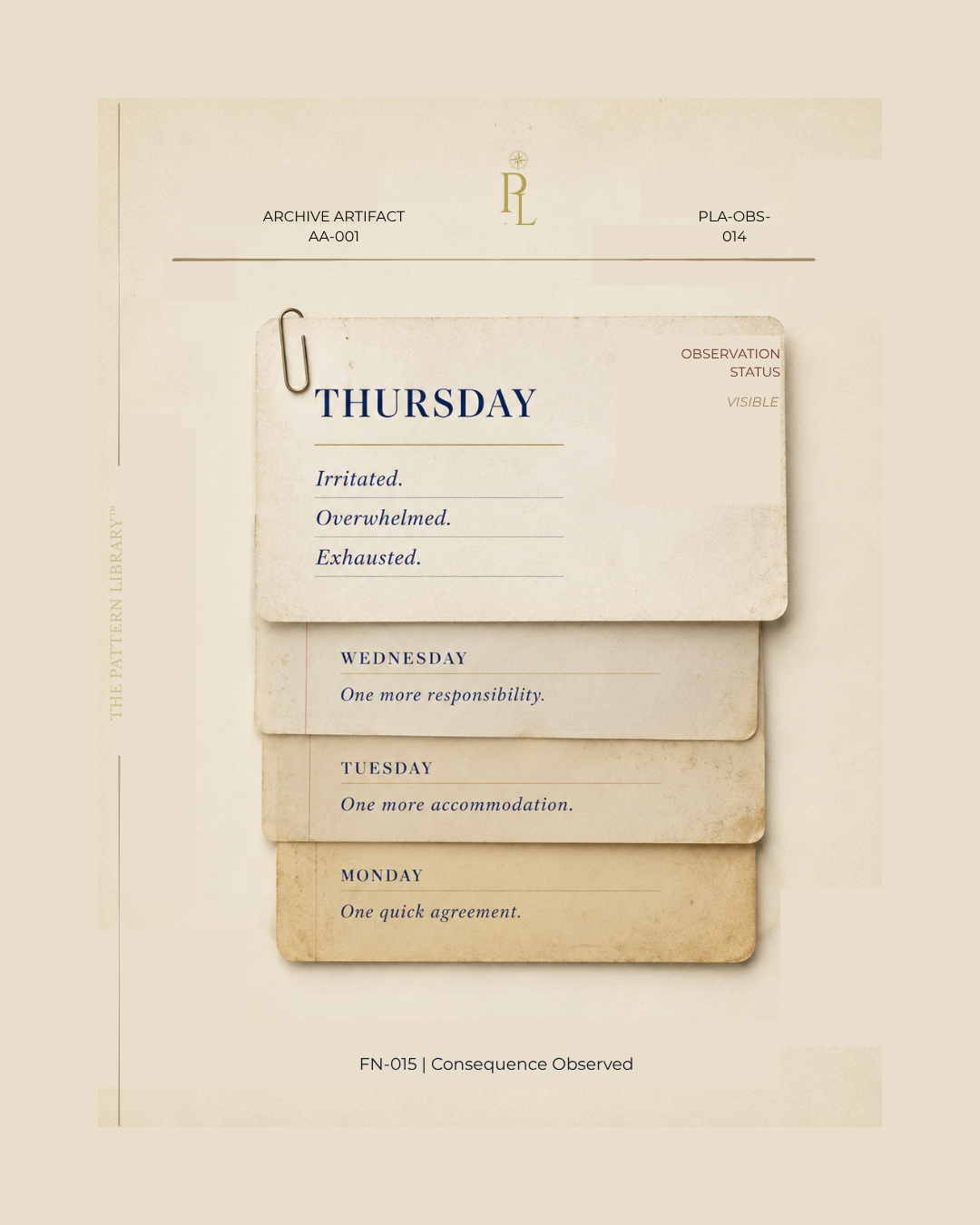
The week that felt overwhelming on Friday may have started taking shape much earlier.
Not through a major decision.
Through a series of ordinary ones.
A request accepted without much thought.
A commitment squeezed into an already full calendar.
An interruption that redirected attention.
A responsibility absorbed because it seemed easier than discussing it.
None of these moments seem particularly significant on their own. In fact, most would be forgotten within a few hours.
Yet life is rarely shaped by one decision.
It is shaped by the accumulation of many.
And accumulation is notoriously difficult to see while it is happening.
The Challenge of Accumulation
Imagine placing a single sheet of paper on a table.
It weighs almost nothing.
Add another.
Still nothing noticeable.
Keep going.
For quite some time, the growing stack appears inconsequential.
Then eventually there comes a point where the accumulation becomes impossible to ignore.
The interesting question is not when the stack became heavy.
The interesting question is when the accumulation began.
Many of the consequences women describe seem to follow a similar pattern.
The resentment wasn't created in a single afternoon.
The overwhelm wasn't born during one busy week.
The feeling that your time no longer belongs to you rarely arrives all at once.
Instead, these experiences appear to emerge gradually, built from moments that felt insignificant while they were occurring.
The consequence gets noticed because it is visible.
The accumulation remains largely invisible because it happened slowly.
Looking at the Pattern Instead
This is where The Pattern Library begins.
Not with the consequence.
With the curiosity to look beyond it.
Rather than asking why someone feels overwhelmed, I find myself asking a different question.
What happened before the overwhelm appeared?
What sequence of decisions, responses, assumptions, obligations, or habits quietly created the conditions for it?
The same question applies almost everywhere.
What happened before the resentment?
What happened before the exhaustion?
What happened before the frustration?
Often the answer isn't a dramatic event.
It's a pattern.
And patterns are easy to miss because they rarely look important while they are forming.
They look ordinary.
They look familiar.
They look like everyday life.
Field Notes
The longer I study behavioral patterns, the less interested I become in consequences by themselves.
Consequences are useful, but mostly because they leave clues.
They point toward something.
They suggest there is more to the story than what first captured our attention.
Perhaps that's why so many people feel stuck trying to solve the same problems over and over again. They focus on the visible outcome while the underlying pattern continues operating quietly in the background.
If there is a central idea emerging from this observation, it is simply this:
Consequences are usually what get our attention.
Patterns are usually what got us there.
From the Archive
This observation was adapted from Field Note 015: The Consequence Is Lous. The Pattern Is Quiet.
For the complete investigation, examples, and archive artifacts, read the full Field Note on Substack.