
The Unread Book: What It Quietly Reveals About the Life You Meant to Live

The Unread Book
It is difficult to say how many evenings the book had been waiting.
Not because anyone had forgotten it, but because forgetting suggests a kind of absence that never quite happened. The book remained exactly where it had been left, its bookmark resting patiently between two chapters as though the interruption had lasted only a few minutes instead of several days.
Nothing about it suggested abandonment.
Quite the opposite.
It still looked like someone intended to return.
Hardcover books age differently than paperbacks. Their covers soften at the corners where they have been held repeatedly. The jacket begins carrying faint impressions of fingertips that reached for it night after night. They become, in a quiet way, records of attention.
An unread book changes very little.
It waits almost exactly as it was left.
This is not one of those books.
This is the book resting on the corner of the table, exactly where it has been for several evenings. A bookmark still holds its place between the pages, patiently preserving a conversation that expected to continue. Dust has not yet settled across the cover. Nothing about it suggests neglect. If anything, it still carries the quiet optimism of something temporarily interrupted.
Someone intended to come back.
That much is obvious.
The remarkable thing is not that the book remains unfinished. Most of us have shelves filled with stories we never completed. What interests me is a different kind of book entirely—the one we fully intended to read, the one we were enjoying, the one that somehow became easier to postpone than almost everything else.
There is something strangely revealing about that moment.
Reading is one of the few activities we rarely do for anyone else's benefit. No one is waiting for us to finish the next chapter. There is no deadline attached to a novel waiting on the table. The book asks for nothing except our attention, offered freely and without urgency.
Perhaps that is why it becomes so easy to leave behind.
Life has an endless supply of interruptions that feel more deserving. Dinner needs to be cleaned up. A text message should probably be answered. Tomorrow's calendar deserves a quick look before bed. Someone needs a ride. The laundry is nearly finished. None of these moments seem particularly significant on their own, and each asks for only a few minutes.
The book waits.
It always has.
It assumes there will be another evening.
And perhaps there will.
The Evidence
What interests me is not that the evening failed to arrive, but that somewhere along the way, we quietly accepted the idea that the easiest promise to postpone was the one we had made only to ourselves.
The bookmark never argues.
It simply remains where we left it, preserving not only the place in the story, but perhaps something else as well.
The bookmark preserved more than a page. It quietly held open the possibility that one evening, the conversation would continue.
Following the Evidence
There is a difference between a book that has been finished and a book that has been abandoned.
One closes with satisfaction. The other with finality.
An unread book occupies neither of those places.
It lives somewhere in between.
Its pages remain open to possibility, held there by a bookmark that quietly insists the story has merely paused. Nothing about the book suggests it has been forgotten. It hasn't been returned to the shelf. It hasn't been donated or placed in a stack destined for the used bookstore. It continues occupying its familiar place on the table as though expecting its reader to return at any moment.
There is a certain optimism built into that expectation.
The bookmark assumes continuity.
It does not know whether an hour or a month has passed. It simply keeps watch over the place where the conversation stopped, preserving it with remarkable patience. Unlike so many things in our lives that demand immediate attention, the bookmark never interrupts. It never reminds. It never asks.
It waits.
Perhaps that is why it captures my attention so often.
A bookmark is one of the few objects whose entire purpose is to remember something for us. It quietly holds our place until we are ready to continue, asking nothing in return except the hope that we eventually will. In that sense, it becomes a small act of trust between the reader and the future version of herself.
You'll come back.
At least, that is what the bookmark seems to believe.
I have often wondered why unfinished books feel different from books we simply choose not to finish.
There are novels that fail to hold our attention. We close them without regret and eventually forget they were ever part of our lives. There is no lingering relationship with those stories because the decision has already been made. They have completed their work, even if we never reached the final chapter.
An unread book is different.
Its story continues unfolding without us.
Each day it waits on the table, it quietly reminds us that there was once an evening we imagined differently. Perhaps we pictured ourselves settling into the chair with a cup of tea. Perhaps we imagined reading for an hour before bed, allowing the world to grow smaller as another world slowly unfolded across the page.
Those evenings never arrive in quite the way we imagined.
Not because they were impossible.
Because they were interrupted.
Interruption is such an ordinary part of life that we rarely question it.
The phone rings.
Someone asks a question from another room.
The dishwasher finishes its cycle.
A quick glance at tomorrow's calendar becomes fifteen minutes of rearranging appointments. An email arrives that seems easier to answer now than tomorrow morning. None of these moments appear significant enough to remember later.
Yet they possess something the book does not.
Urgency.
The book never competes for our attention.
It simply offers itself whenever attention becomes available.
That is both its greatest kindness and, perhaps, its greatest disadvantage.
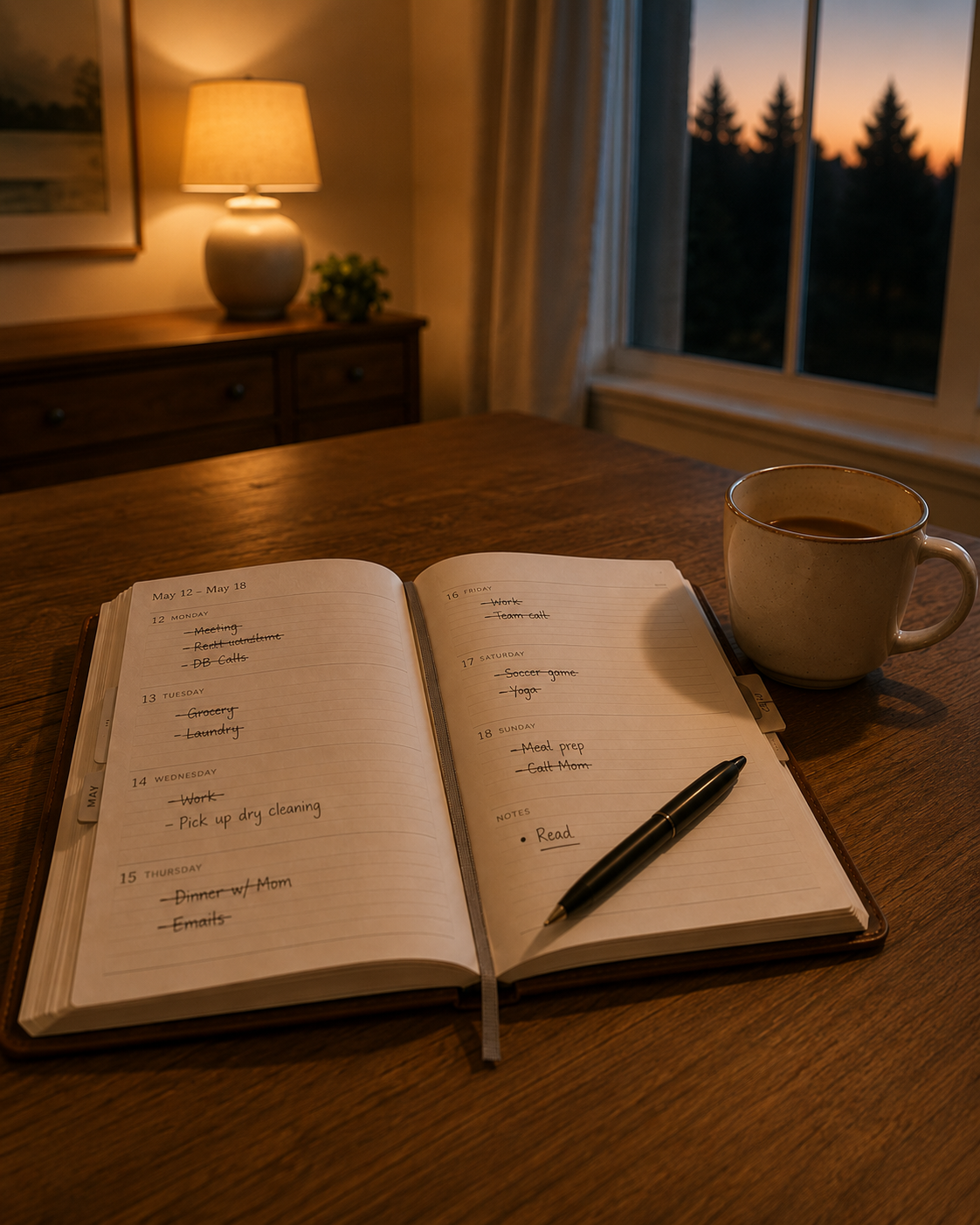
There is another detail that quietly interests me.
An unread book almost always remains visible.
We do not tuck it into a drawer where it disappears from sight. We leave it where it can be seen, passing it several times a day without feeling any particular urgency to open it again. Over time, it begins blending into the landscape of the room, becoming as familiar as the lamp beside it or the framed photograph across the mantel.
Its presence no longer surprises us.
Neither does its absence from our evenings.
That may be the most curious part of all.
How easily something we once looked forward to can become part of the background without either of us ever deciding that it should.
The Pattern Behind the Pattern
Eventually, I stopped seeing the book as unfinished.
I began seeing it as evidence.
Not evidence that someone had failed.
Not evidence that life had become too busy.
Something quieter than that.
Evidence that the promises we make only to ourselves often possess the remarkable ability to wait without complaint.
The book never argues.
Neither does the bookmark.
There comes a point in every investigation when the object itself begins asking a different question.
The unread book no longer invites us to wonder why we stopped reading.
It asks something far quieter.
What else have we quietly stopped returning to?
That question lingered with me far longer than I expected.
Not because I couldn't answer it, but because every answer seemed to lead somewhere unexpected. I thought I was noticing books. Then I began seeing half-finished knitting projects folded carefully into baskets, watercolor brushes resting exactly where they had been rinsed weeks earlier, walking shoes waiting faithfully beside the door, cameras tucked safely into closets, musical instruments gathering just enough dust to suggest they had once been played often.
None of these objects appeared neglected.
In fact, they often remained exactly where they could be seen.
Almost as though the people who owned them still expected to return.
Perhaps they did.
Perhaps that is what makes these objects so quietly compelling. They do not represent abandoned dreams. They represent interrupted relationships.
Not relationships with other people.
Relationships with the parts of ourselves that ask for nothing except our own attention.
That distinction matters.
A forgotten appointment carries consequences. A missed deadline demands explanation. Responsibilities have a way of announcing themselves with increasing urgency until they are finally addressed.
The unread book behaves differently.
It offers remarkable grace.
It never insists.
It never competes.
It quietly trusts that whenever we are ready, the story will still be waiting.
That generosity is beautiful.
It is also what makes it so easy to overlook.
I have often wondered whether the things we postpone most easily have something important in common.
Not because they matter less.
Perhaps because they belong entirely to us.
No one else is inconvenienced if another chapter waits until tomorrow.
No one notices if the watercolor paints remain unopened for another week.
No meeting is cancelled because the guitar stayed on its stand.
The cost appears almost invisible.
At least in the beginning.
Over time, however, another possibility begins to emerge.
What if these objects are not quietly documenting what we failed to finish?
What if they are documenting something far more interesting?
The order in which our attention leaves us.
Not all at once.
Not dramatically.
One perfectly reasonable interruption at a time.
That thought stayed with me for months.
Long before I gave it a name.
Long before I understood where the pattern truly began.
I simply couldn't ignore the quiet consistency with which the promises made only to ourselves seemed willing to wait.
Almost as though they had learned they would always be asked to.

From the Archivist's Desk
Some observations remain in the archive because they answer questions.
Others remain because they continue asking them.
The unread book has not yet finished asking mine.
Continue the Investigation
This essay is one observation drawn from the ongoing research contained in Field Note 016: Everything Gets Done. Except Your Stuff.
If you'd like to follow the investigation as it unfolds, you're invited to join the Archive and receive new Field Notes, Pattern Notes, and observations before they're published elsewhere.
→ Enter the Archive
Research Question
When you look around your home tonight, what has been quietly waiting for you?