Mental Carryover™: Why Your Brain Still Feels Busy At Night

The Mental Tabs Never Closed
Why You Feel Busy Even When The Day Is Over
You finally sit down for the first time all day.
The dishes are done.
The emails are answered.
The laundry is folded.
Nothing urgent is happening anymore.
And yet your brain is still moving.
You remember a text you forgot to answer.
You wonder if you confirmed Thursday's appointment.
You think about the volunteer thing you said you'd handle.
You mentally rehearse a conversation that hasn't happened yet.
The day is over.
But somehow it doesn't feel over.
Most women assume this means they're stressed.
I don't think that's what's happening.
I think you're carrying something much quieter.
Something most people never notice.
Mental tabs.
Open loops of responsibility your brain is still tracking long after the moment has passed.
I call this Mental Carryover™.
The agreement ended.
The mental tab didn't.
The Work Is Done. The Responsibility Isn't.
One of the biggest misconceptions about overwhelm is that it comes from doing too much.
Sometimes it does.
But often the exhaustion arrives long after the work itself is finished.
Think about how many things you carry that aren't actually happening anymore.
The email that already ended.
The conversation that's over.
The favor you agreed to next week.
The appointment that's still three days away.
The volunteer commitment that's sitting quietly in the background.
None of these require action right now.
Yet somehow they're all consuming attention.
Your body moved on.
Your brain didn't.
And every open mental tab demands a little bit of energy.
Not enough to notice immediately.
Just enough to slowly drain your capacity throughout the day.
Why Your Evenings Never Feel Finished
Have you ever reached the end of the day and thought:
"I didn't even do that much today."
Yet you still feel exhausted?
That's often Mental Carryover™ at work.
Because your nervous system doesn't only respond to physical activity.
It responds to responsibility.
The more obligations your brain is tracking, the harder it becomes to fully relax.
That's why scrolling doesn't feel restful.
That's why sitting down doesn't feel peaceful.
That's why your evening can feel strangely unfinished even when your task list is technically complete.
The work may be finished.
The thinking isn't.
When You Think You're Resting
Maybe this feels familiar.
You finally get a quiet moment.
The television is on.
You're sitting on the couch.
Nothing is being asked of you.
But your brain is still working.
You remember the text you forgot to answer.
You think about next week's appointment.
You replay a conversation from earlier.
You mentally organize tomorrow before it even arrives.
From the outside, it looks like you're resting.
Inside, you're still managing.
That's why so many women say:
"I never feel fully off."
The work ended.
The responsibility didn't.
The Hidden Cost Of Open Mental Tabs
Most mental tabs begin with something incredibly small.
A quick agreement.
A casual commitment.
A simple "sure."
Nothing dramatic.
Nothing that feels important.
But once your brain accepts responsibility for something, it begins tracking it.
Quietly.
Automatically.
Continuously.
This is why one tiny commitment can create hours of invisible mental activity.
Not because the task is difficult.
Because your brain is trying not to forget it.
And when enough of these tabs accumulate, they create a constant background hum of responsibility.
A feeling many women describe as:
"I can never fully shut my brain off."
The Earlier Patterns That Created This
Mental Carryover™ rarely begins at night.
The exhaustion is simply when you notice it.
The pattern usually starts much earlier.
A decision gets made too quickly.
An agreement happens automatically.
Awareness arrives after the commitment.
The cost remains invisible.
The responsibility follows you.
The pattern often looks like this:
Decision Timing™
↓
Automatic Yes™
↓
Response Mode™
↓
Hidden Cost Loop™
↓
Mental Carryover™
By the time you're lying in bed thinking about tomorrow, the original decision is often forgotten.
But the consequence remains.
The Moment Most Women Miss
Most women believe the problem is the exhaustion.
It isn't.
The exhaustion is the evidence.
The actual moment that matters happened much earlier.
It happened when the responsibility entered the system.
The quick agreement.
The automatic response.
The commitment accepted before the future impact was fully considered.
That's the moment most people never notice.
And because they don't notice it, they keep repeating it.
Again.
And again.
And again.
Until their evenings feel heavy, their weekends feel crowded, and their minds never seem to stop working.
What To Notice This Week
Tonight, before bed, ask yourself one simple question:
What am I still mentally carrying that is no longer physically happening?
Don't judge it.
Just notice it.
You may discover that your exhaustion isn't coming from today's work.
It's coming from yesterday's agreements.
And last week's commitments.
And all the open tabs your brain is still trying to hold together.
Awareness begins when you notice what you're carrying.
Change begins when you notice how it got there.
Pattern Map: How Mental Carryover™ Happens
This is what most women never see happening in real time.
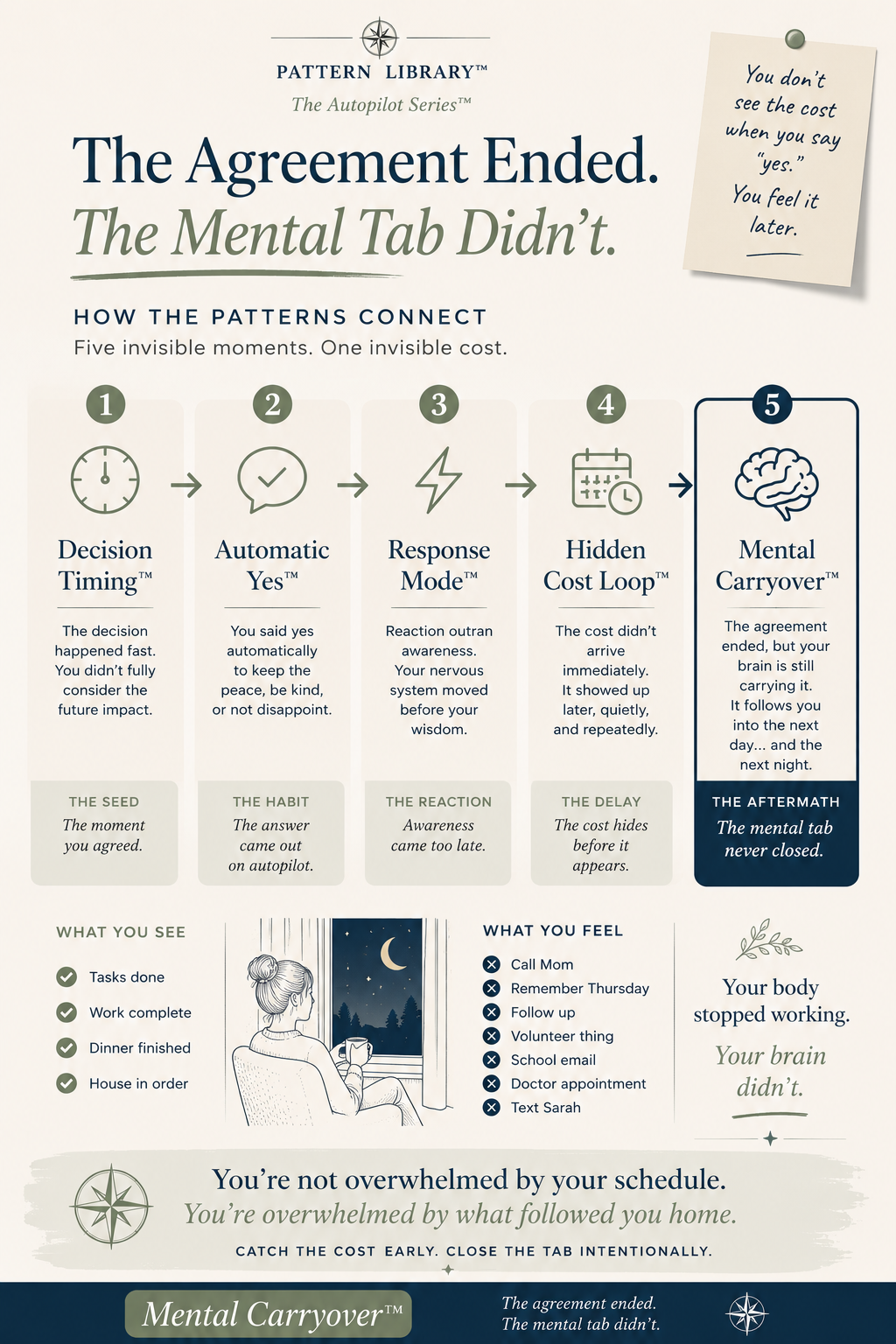
The exhaustion isn't random.
It's patterned.
How Mental Carryover™ Gets Created
If Mental Carryover™ feels familiar, these related patterns may help you understand how it started:
Decision Timing™
The Follow-Through Trap | Decision Timing™
The decision happened before you fully considered the future impact.
Automatic Yes™
Why Capable Women Say Yes Too Fast | Automatic Yes™
The agreement happened before you consciously chose.
Response Mode™
The Busy Trap | Response Mode™
The response happened before awareness arrived.
Hidden Cost Loop™
Your Evening Paid For The Earlier Yes | Hidden Cost Loop™
The cost wasn't visible when the decision was made. It appeared later.
Together, these patterns create the invisible Mental Carryover™ many women carry every day.
Ready To Catch the Cost Earlier?
Most women don't recognize the hidden costs of their decisions until they're already carrying them.
The Hidden Cost Reset™ helps you identify emotional, schedule, and capacity costs before they quietly compound into overwhelm.
Because the agreement may end.
But the responsibility often follows you home.
Start the Hidden Cost Reset™