
How Long a Layover Do You Really Need? A Flight Attendant's Honest Answer
The short answer: Give yourself 90 minutes for a domestic connection on one ticket, and three hours when you're flying home from abroad and clearing customs. The airline's minimum connection time is what's legal, not what's comfortable.
What's inside: my layover cheat sheet for every kind of connection · what really happens at customs when you fly home · why separate tickets need four hours or a night's stay
I'm Elizabeth, and this is The Well-Traveled Woman.
I'm an international flight attendant and a private pilot, and I spent 30 years in the legal world before that. I've been to 28 countries, and I'm in an airport almost every week. So when you ask me, "Is an hour layover enough?", I don't answer with what the airline allows. I answer with what I'd book for myself.

Why "legal" isn't the same as "comfortable"
Every airline sets a minimum connection time for each airport. It's the shortest gap they'll sell you on one ticket. If the booking site shows a 50-minute connection, somebody decided you can make it. On a perfect day, you probably can.
But that minimum assumes the first flight leaves on time, lands on time, gets a gate right away, and the jet bridge works. It assumes your next gate isn't in another terminal. It assumes nobody in front of you is wrestling a bag out of the overhead bin.
I know this one personally. I've spent what feels like half my life connecting through Atlanta's Hartsfield-Jackson airport, first as a kid flying between my parents and then as an adult. Let me tell you, sprinting to make a connection is not fun. It's stressful the whole way, wondering if you're going to make it. Most of the time I did. But there were plenty of times I was waiting for the flight the next day. Even in my younger years, 60 minutes in Atlanta was not enough for me.
I've seen it from the other side, too. Working the back of the cabin on a delayed flight, I've watched countless people miss their connection to the last flight of the night. My heart goes out to them. Lots of flights into smaller airports are the last one out for the night. Miss it, and your options become hanging out at the airport all night or getting a hotel on your own dime for some rest, because sometimes the first flight of the day isn't available either. So if your connecting flight is the last one out, have a plan B before you leave home.
Book the layover that lets you walk to the gate. Not run.
How long a layover do you need? My numbers
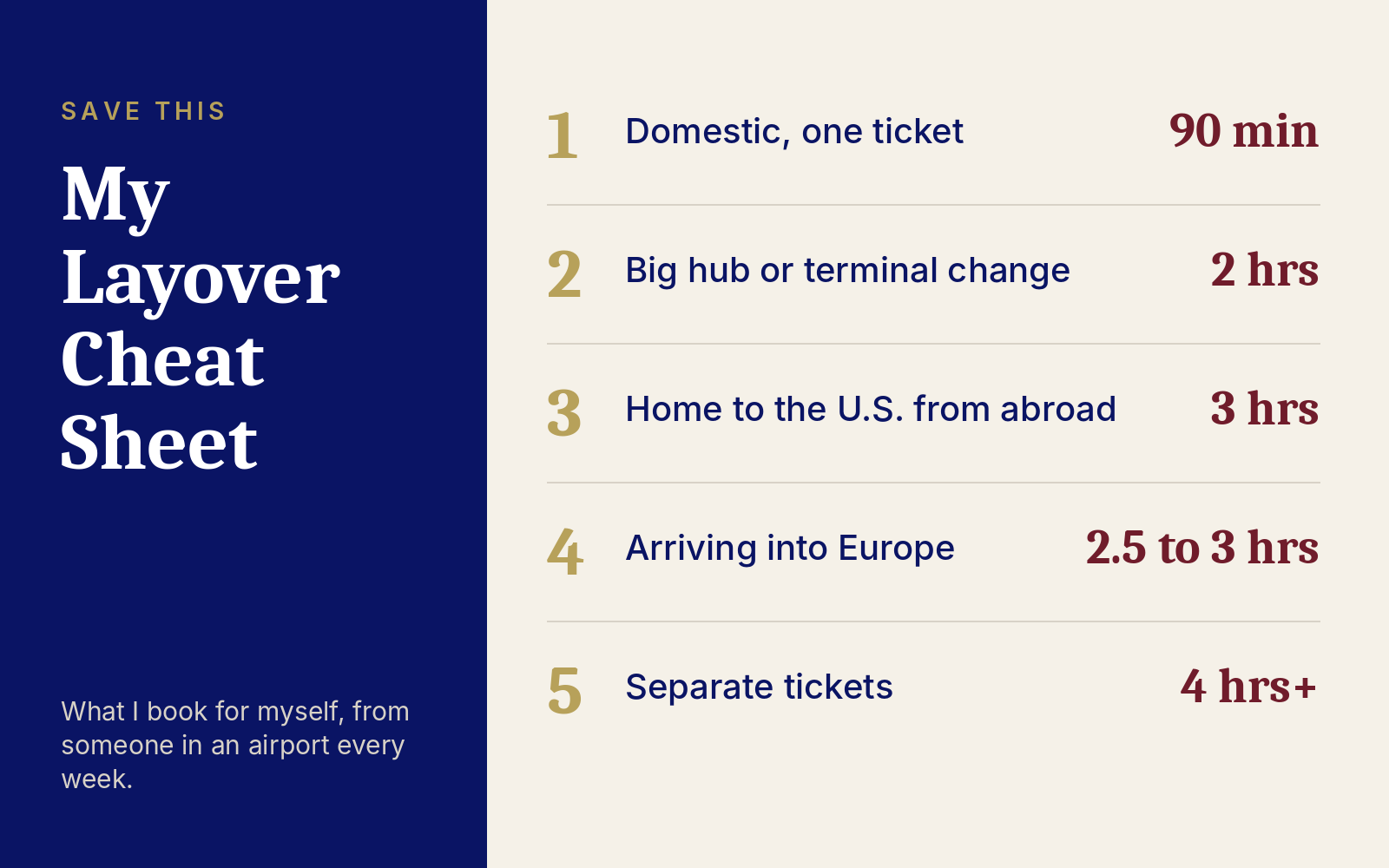
Here's what I actually book. Save this one.
- Domestic, one ticket, same terminal: 90 minutes. An hour works on a good day. Ninety minutes works on a normal one.
- A big hub, a terminal change, or winter weather: 2 hours. Big airports mean long walks and trains between concourses. Winter means de-icing and delays that stack up.
- Flying home to the U.S. from abroad: 3 hours. More on this below. It's the one that catches people.
- Arriving into Europe and connecting on: 2.5 to 3 hours. You'll go through passport control at your first stop in the Schengen area, even if your final city is somewhere else.
- Two separate tickets: 4 hours or more, or stay the night. No exceptions.
The airport layer: what happens when you fly home from abroad
This is the part nobody explains until you're standing in it.
When you fly into the U.S. from another country, you clear customs at the first U.S. airport you land in. Not your home airport. The first one. Then you pick up your checked bags, hand them back to the airline to recheck, and go through TSA security again before you can walk to your next gate.
That's three lines, not one. At busy airports, customs alone can take an hour or more at peak times. Add a long walk, a slow bag belt, and a security line, and a 90-minute connection gets very tight.
Two things help. If you have Global Entry, use it. If you don't, the free CBP MPC app (Mobile Passport Control) lets U.S. citizens send their passport details ahead and use a separate line at many airports. It's not as fast as Global Entry, but it's free and it often helps.
Flying into Europe has its own new wrinkle. The European Union's Entry/Exit System has been fully running since April 2026. The first time you enter the Schengen area under it, they'll take your fingerprints and a photo at the border. During the rollout, some airports had lines that ran for hours. Give yourself room.
Coming home from abroad, you don't have one line to get through. You have three.
Separate tickets: the layover that isn't protected
Sometimes a booking site stitches together two flights on two different airlines, or you book the second leg yourself to save money. That's two tickets, and two separate contracts.
On one ticket, if your first flight is late and you miss the second, the airline rebooks you. On two tickets, the second airline has no reason to wait for you or to give you a new seat for free. You're a no-show. Your checked bag may not be sent through, either, which means collecting it, rechecking it, and going back through security.
So when the cheaper option is two tickets with a 75-minute gap, I don't call that a deal. I call it a gamble with your first night of vacation. Leave four hours or more, or plan to stay overnight and start fresh.
Run it through the Worth-It Method
Before I book any connection, I ask five questions.
- Worth the money? A tight layover that saves $60 isn't worth it if missing it costs you a hotel night and a lost day.
- Worth the time? An extra hour in an airport feels long. A missed connection and a next-morning flight feels longer.
- Worth the hassle? Running through a terminal with a carry-on, or walking it with a coffee in your hand. You pick.
- Worth the upgrade? If you're paying more, pay for the better connection before the better seat. A nonstop, when there is one, is often the best upgrade of all.
- Worth the memory? Nobody remembers the layover that went fine. Everyone remembers the one that didn't.

A few crew habits for any layover
- Pick a seat near the front on the first flight when your connection is tight. You'll be off the plane sooner.
- Check your next gate before you land. Your airline app usually shows it. Know which way to turn when you step off.
- Avoid the last flight of the day as your second leg. If you miss it, there's nothing left until morning.
- Need help getting through the airport? Request wheelchair or mobility assistance when you book, and confirm it at check-in. It's there for you. Use it.
- Always have a plan B. Know the next flight to your destination before you leave home. If you miss your connection, you'll already know what to ask for.
Not cheaper. Worth it. The extra hour is the cheapest calm you'll ever buy.
My verdict
Keep: the 90-minute domestic connection on one ticket.
Reconsider: anything under an hour, and anything under three hours when you're clearing customs.
Skip: short layovers on separate tickets.
Spend here: the earlier flight, or the nonstop. It's the best money you'll spend on the whole trip.
Questions women ask me about layovers
Is a one-hour layover enough?
For a domestic connection on one ticket, in the same terminal, at a smaller airport, often yes. Anywhere else, I'd want 90 minutes. If you're clearing customs, an hour is not enough.
What happens if I miss my connecting flight?
If both flights are on one ticket, the airline will rebook you. Check with your airline to see which flight they're putting you on, then decide what works best for you. If it's the next morning, you can wait at the airport or get a room and rest. Ask whether they'll cover a hotel, but if the delay was weather or something else outside the airline's control, plan on paying for it yourself. If your flights are on separate tickets, the second airline usually doesn't owe you a new seat, and you may have to buy one.
Do I have to get my bags when I connect?
On a domestic connection on one ticket, usually not. Your bag is checked through. When you fly into the U.S. from abroad, yes: you collect your bags after customs and recheck them. On separate tickets, plan to collect and recheck.
Is a long layover a waste of time?
Not to me. A longer layover is time for a real meal, a walk, and a coffee you can taste. It's the part of the trip where you get to breathe.
Before you book your next trip
If you've been saying "someday" about a trip for years, I made something for you. Off Standby is my free, private podcast for women who are done waiting for the perfect time. Short episodes, recorded between my own flights.

Listen free: elizabethgarrison.com/off-standby
You've been on standby long enough.
The world is worth doing right. ✈️
Elizabeth · The Well-Traveled Woman